From README.md in the repository.
Carbon ownership, not carbon awareness.
A full-stack carbon-footprint prototype with a deterministic accounting engine, a FastAPI backend and a Next.js frontend. The repository includes security and accessibility tests; this is a student project, not a security-audited production service.




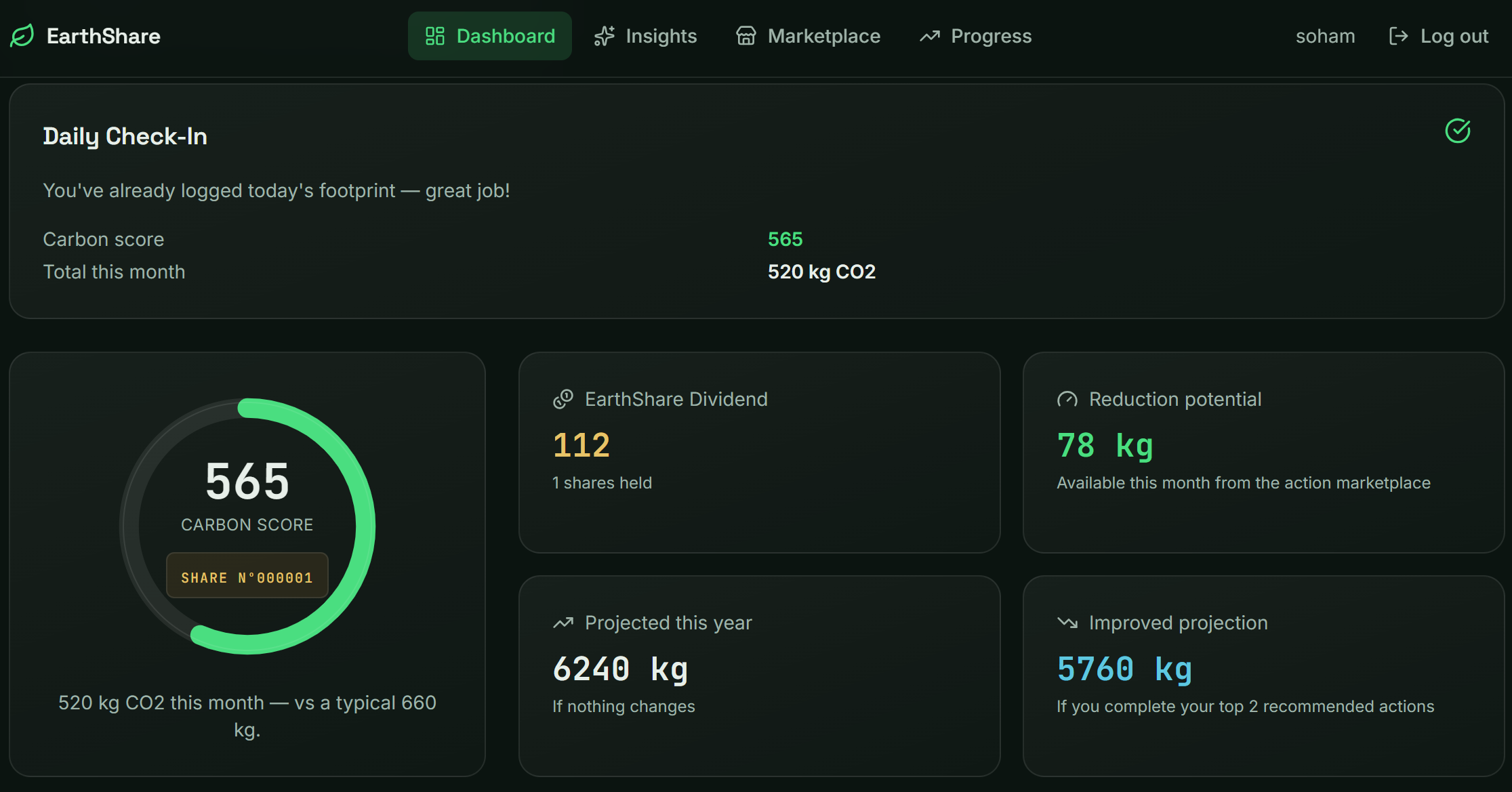
The dashboard screen. More screens in the product walkthrough.
Project summary
What it is: EarthShare is a carbon-footprint prototype. Users record everyday activities, receive deterministic emission estimates, view insights, and track progress by completing suggested climate actions.
Why it's different: Most carbon apps focus on awareness (charts, streaks, badges). EarthShare focuses on ownership (account, measure, neutralize). The behavioral model is the product.
Engineering: The backend includes JWT authentication, rate limiting, configurable CORS middleware, security headers, and request-schema validation. Carbon calculations are deterministic and do not use an LLM. SQLite is the local default; PostgreSQL migration and production deployment have not been verified.
Local setup
Prerequisites
- Python 3.11 or another version supported by the installed backend dependencies.
- Node.js and npm.
- No Gemini API key is required for local use; without one, insights use the rule-based fallback.
Backend
From the repository root:
git clone https://github.com/Soham-o/EarthShare.git
cd EarthShare
python -m venv backend/.venv
# Activate the environment:
# macOS/Linux: source backend/.venv/bin/activate
# Windows PowerShell: .\backend\.venv\Scripts\Activate.ps1
python -m pip install -r backend/requirements.txt
Copy backend/.env.example to backend/.env, then start the API:
# macOS/Linux
cp backend/.env.example backend/.env
# Windows PowerShell: Copy-Item backend/.env.example backend/.env

cd backend
uvicorn app.main:app --reload
The API defaults to local SQLite and is available at http://localhost:8000.
Frontend
In a second terminal from the repository root:
cd frontend
npm ci
Copy frontend/.env.example to .env.local in the frontend/ directory, then run:
# macOS/Linux
cp .env.example .env.local
# Windows PowerShell: Copy-Item .env.example .env.local

npm run dev
Open http://localhost:3000. The frontend's default API URL is http://localhost:8000. Never use the example JWT secret in a production deployment; configure a unique secret and explicit trusted CORS origins.
Tests
# Backend (from repository root, with the Python environment active)
cd backend
python -m pytest -q

# Frontend (in a second terminal, from repository root)
cd frontend
npm ci
npm test
npm run build
GitHub Actions runs backend tests, frontend tests and a frontend build for pull requests to main and pushes to main or fix/**.
1. Problem Statement Alignment
Why the challenge exists
Individual emissions are a meaningful slice of the climate problem, but they are largely invisible to the people producing them. People want to act, but they have no reliable, low-friction way to (a) measure their impact, (b) understand what's driving it, and (c) actually neutralize it. The result is a gap between intent and action.
- Awareness without accountability. Most apps surface a number and a streak, then leave the user to feel bad. There's no mechanism to close the loop.
- Opaque calculations. Estimates often come from black-box models or third-party APIs that can drift, fail, or change pricing — making results non-reproducible and hard to trust.
- Heavy onboarding. Long questionnaires kill retention before the first insight.
- Offsets are an afterthought. Where offsets exist, they are usually disconnected from the user's actual measured footprint.
Why ownership is a better behavioral model than awareness
Awareness asks: "Do you know your number?"
Ownership asks: "What are you going to do about your number?"
EarthShare is designed around a single behavioral loop:
Log → Measure → Understand → Reduce or Offset → Repeat.
Every screen, every endpoint, and every data model exists to shorten the distance between a logged activity and a neutralized footprint. Ownership is the product.
2. Technical Excellence
Clean Architecture
The backend is organized into clearly separated layers — routes → services → repositories → models — so that business rules don't depend on framework details and the framework doesn't leak into business rules. This means:
- Routes are thin: they parse, validate, and delegate.
- Services own business logic and orchestrate repositories.
- Repositories own persistence. Nothing else touches the ORM.
- Models are plain data definitions.
Service Layer Pattern
All non-trivial logic — carbon calculation orchestration, user lifecycle, offset purchase flows, insight aggregation — lives in services. This keeps routes testable in isolation and lets us swap delivery mechanisms (HTTP today, a job runner tomorrow) without rewriting business logic.
Repository Pattern
Every database read/write goes through a repository. Benefits:
- The database URL is centralized in configuration and SQLAlchemy sessions are injected; changing the database still requires a tested migration and deployment path.
- Tests can substitute in-memory or fake repositories trivially.
- Query logic is centralized and reviewable.
Dependency Separation
- The carbon engine depends on nothing but Python stdlib and a static emission-factor table.
- Services depend on repository interfaces, not concrete DB classes.
- Routes depend on services, not on the ORM.
- The frontend depends on a single typed API client, not on scattered
fetch calls.
This is what makes the codebase easy to read, easy to test, and easy to extend.
API Design
- Versioned API routes cover authentication, onboarding, dashboard data, insights, actions, progress and daily check-ins under
/api/v1.
- Consistent JSON envelopes for success and error responses.
- Structured HTTP responses use appropriate status codes for validation, authentication, missing resources, conflicts, rate limits and server errors.
- Stateless authentication via JWT bearer tokens.
Deterministic Carbon Engine
The core calculator is pure, deterministic, and offline. Given the same input, it always returns the same number. There is no LLM, no external API, and no randomness in the calculation path. This matters because:
- Results are reproducible — a judge can compute them by hand.
- Results are auditable — every factor is traceable to a source row.
- Results are fast — calculations are O(1) lookups + arithmetic.
- Results are offline-safe — no third-party outage can break the core product.
LLMs, if used at all, are confined to explanations and suggestions on top of the deterministic number — never inside it.
3. Security
Security is implemented as defaults, not features.
- JWT authentication. Stateless bearer tokens with signed payloads, expiry, and explicit verification on every protected route.
- Password hashing. Passwords are stored using a modern adaptive hash (bcrypt-family) with per-user salts. Plaintext is never logged or returned.
- Rate limiting. Sensitive endpoints (login, register, password actions) are rate-limited to blunt brute-force and credential-stuffing attempts.
- CORS configuration. Allowed origins are loaded from the
CORS_ORIGINS environment setting. Configure explicit trusted origins in deployments; the current configuration code does not reject a wildcard automatically.
- Security headers. API responses include
Content-Security-Policy, X-Content-Type-Options, X-Frame-Options, Referrer-Policy and Permissions-Policy. HSTS is enabled for production deployments.
- Input validation. Typed request schemas validate inputs before route handlers call services. Schema-validation errors are typically returned as structured HTTP
422 responses; they should not expose stack traces.
- Error handling. Unexpected exceptions return a generic JSON error, while the server logs the exception with the request method and path. A correlation ID is not currently implemented.
Secrets (JWT signing key, DB URL, allowed origins) are loaded from environment variables only — never committed.
4. Testing
Backend test suite
- Unit tests for the carbon engine (pure functions → exhaustive table-driven cases).
- Unit tests for services with repositories stubbed.
- Integration tests for routes spinning up the app against an ephemeral SQLite DB.
- Auth tests covering registration, login, token expiry, and protected-route rejection.
Frontend test suite
- Component tests cover the daily check-in card, emissions equity ring, form field, option grid and accessibility assertions.
- The current suite is not a complete end-to-end test of all user journeys; manual screen-reader and keyboard-only review has not been verified.
Continuous integration
- GitHub Actions runs the backend test suite, frontend tests and a frontend production build on pull requests and pushes to
main and fix/** branches.
- Latest verified run: 85 backend tests passed, 1 skipped; 21 frontend tests passed; frontend build succeeded. See the CI run.
Coverage notes
- Tests exercise the carbon engine, API routes, authentication, daily check-ins, security headers and selected frontend components.
- The CI suite is a useful regression baseline, not a security certification or proof that every feature is covered.
5. Accessibility
EarthShare targets a WCAG 2.1 AA mindset throughout the UI.
- Keyboard navigation. Every interactive element is reachable and operable via keyboard. Logical tab order, visible focus rings, and no keyboard traps.
- Screen reader support. Semantic HTML first (
<button>, <nav>, <main>, <form>, <label>). Live regions announce async results (e.g. "Activity logged, 2.3 kg CO₂e added").
- ARIA labels. Used to supplement semantics where native HTML can't express intent (icon-only buttons, dynamic counts, modal dialogs).
- WCAG-conscious design. Color is never the only signal; text contrast targets AA ratios; form errors are associated with their inputs via
aria-describedby.
- Responsive layouts. Mobile-first CSS, fluid typography, and breakpoints that keep tap targets ≥ 44px. The dashboard, insights, and marketplace are all usable on a phone in portrait.
6. Efficiency
Why deterministic calculations are computationally efficient
The carbon engine is a pure function over a static emission-factor table. Each calculation is effectively:
emissions = activity_quantity × factor[activity_type][region]
For one activity, the calculation uses a constant-time factor-table lookup and arithmetic; no performance benchmark is published in this repository.
Why local calculations reduce API dependency
The carbon calculation engine runs locally within the backend and uses an in-repository factor table:
- The calculation itself does not require a third-party API call.
- Its calculation path has no per-request model/API fee.
- The factor table can be inspected and versioned with the source.
- Optional insight generation and other app features may still use external services when configured.
Why SQLite was chosen for hackathon deployment simplicity
- Zero-ops: the database is a file. No provisioning, no separate service, no credentials to rotate during a demo.
- Instant local dev: clone, install, run.
- Trivial CI: tests run against an ephemeral in-memory DB.
- Automated backend tests use an in-memory SQLite database; live hosting parity has not been verified.
Database configuration and migration status
The database URL is centralized in backend/app/core/config.py, and the app uses SQLAlchemy sessions and repository classes. SQLite is the verified local/test default. PostgreSQL migration, migrations against a PostgreSQL instance, and production deployment have not been verified, so a connection-string change alone should not be presented as a proven migration path.
7. Why We Chose This Architecture
Goal: Maximize judge-perceivable quality and maximize how far the codebase can travel after the hackathon.
| Decision |
Why |
What it buys us |
| Clean Architecture (routes → services → repos → models) |
Keeps business rules independent of framework and DB |
Easy to test, easy to refactor, easy to read |
| Service layer |
One place for business logic; routes stay thin |
Reusable logic across HTTP, jobs, and tests |
| Repository pattern |
One place for persistence |
Centralizes database access; alternate-database migration still needs validation |
| Deterministic carbon engine |
Reproducibility and auditability beat cleverness here |
Repeatable calculations from a versioned factor table |
| JWT authentication |
Uses signed bearer tokens |
Avoids a server-side session table for token state; production scale is not evaluated |
| SQLite for v1 |
Zero-ops for the demo |
Reliable hackathon-day deploy |
| Configurable database URL |
Keeps the connection setting in one place |
PostgreSQL compatibility remains unverified |
| Typed API client on the frontend |
Single source of truth for request/response shapes |
Fewer integration bugs, better DX |
| Accessibility tests |
Catch selected accessibility regressions early |
Automated accessibility assertions exist; full WCAG conformance is not claimed |
| LLMs out of the calculation path |
Determinism > novelty for a measurement product |
Numbers a judge can verify by hand |
The prototype separates routes, services, repositories, models and schemas, but production readiness, hosted deployment and database migration still need independent validation.
8. Product Walkthrough
Dashboard — at-a-glance footprint, recent activities, and a clear next action.
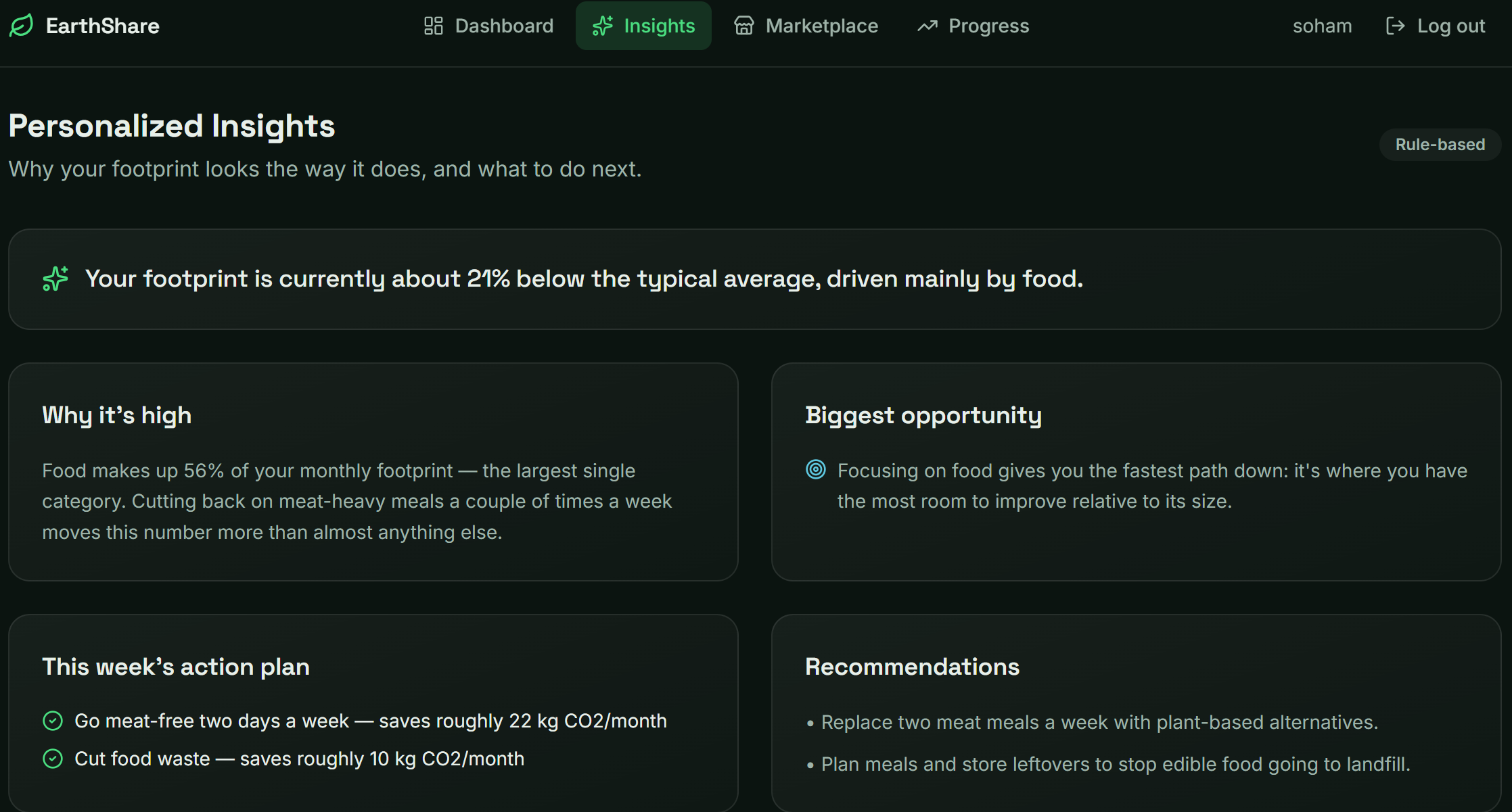
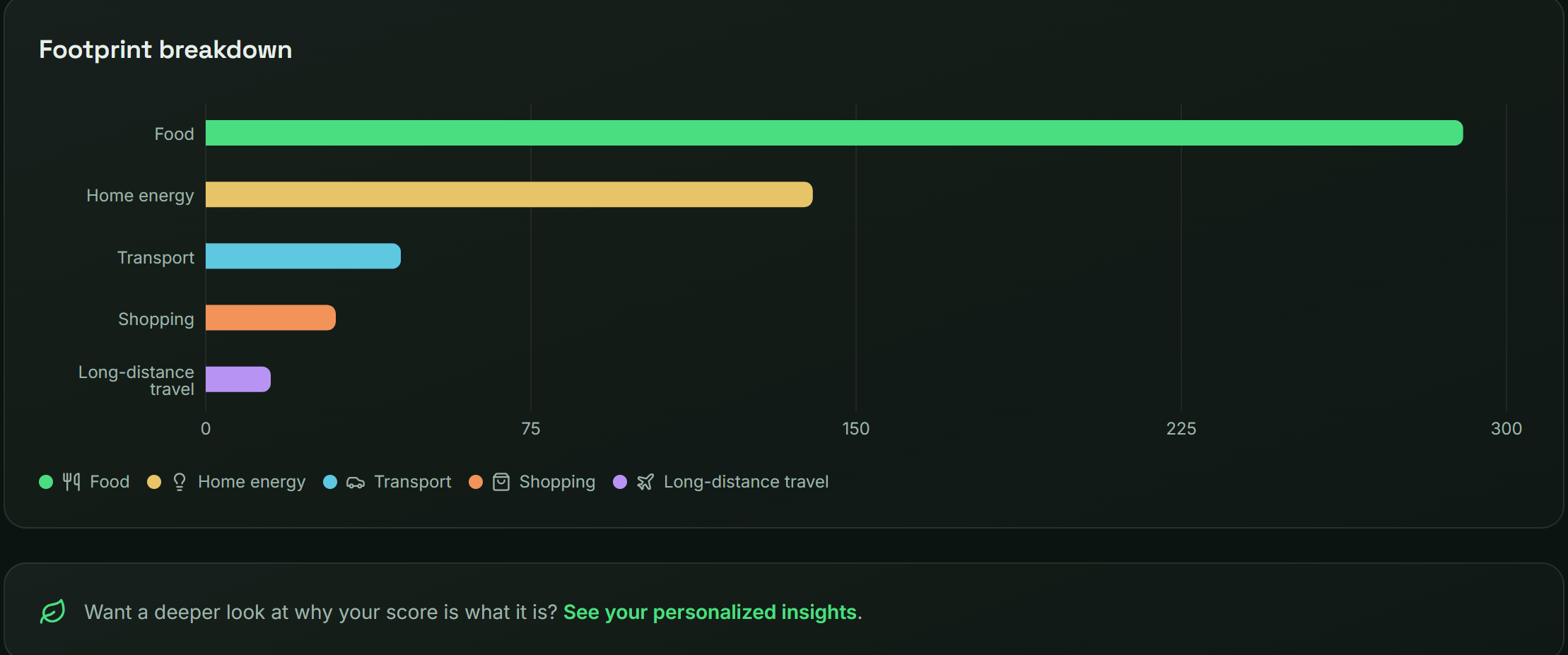
Insights — breakdown by category, trend over time, and the largest contributors to your footprint.
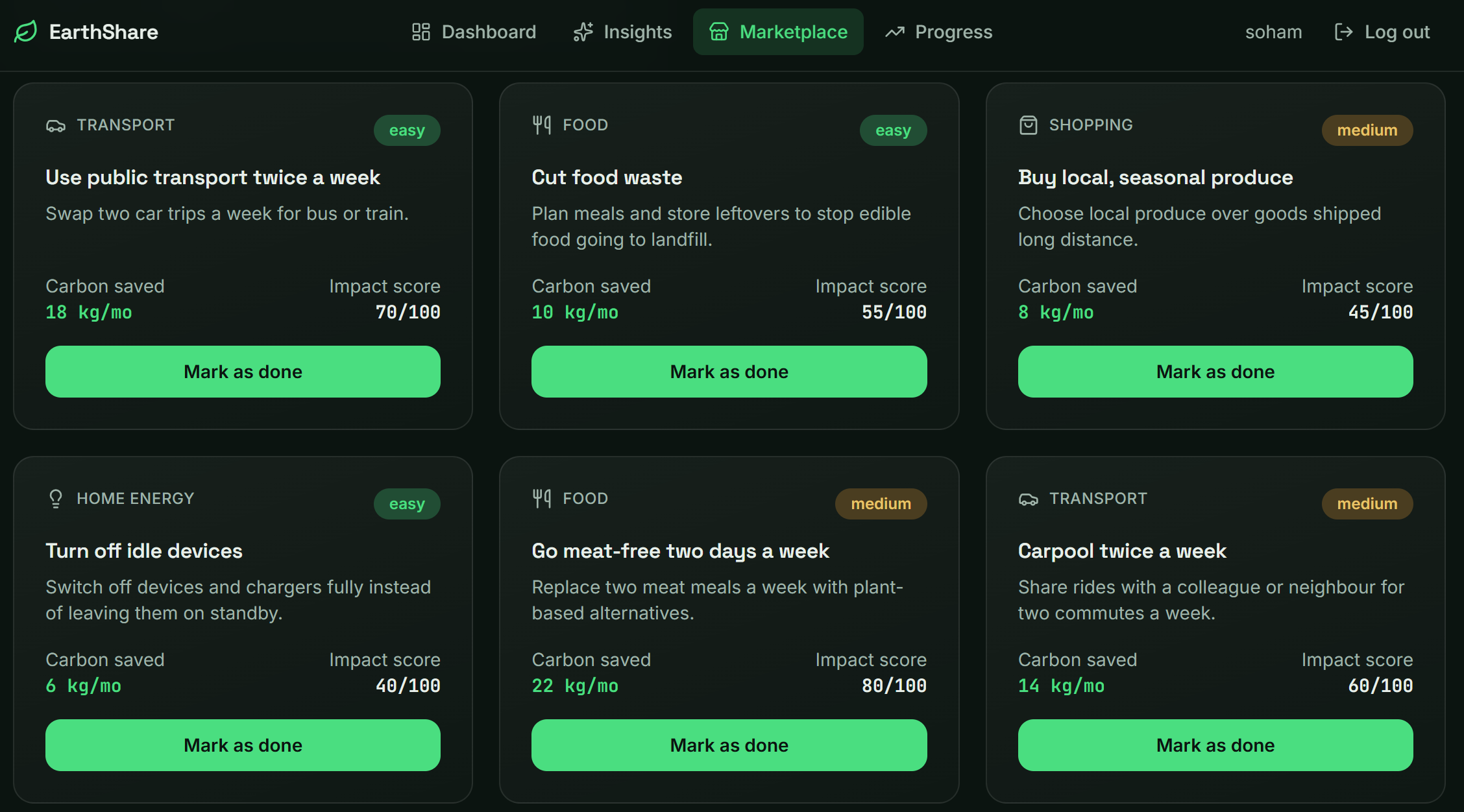
Action marketplace — browse recommended climate actions, mark them complete, and see progress reflected in the app. This is not an offset-credit purchasing marketplace.
Progress — view completed actions, estimated CO₂ savings, weekly trends and badges.
9. Architecture Diagram
flowchart LR
    subgraph Client["🖥️ Frontend"]
        UI["React UI<br/>WCAG-aligned"]
        APIClient["Typed API Client"]
    end

    subgraph Edge["🛡️ Edge Protections"]
        CORS["CORS middleware"]
        RL["Rate Limiter"]
        SH["Secure Headers"]
    end

    subgraph Backend["⚙️ Backend"]
        Routes["Routes Layer<br/>(thin: parse + validate)"]
        Services["Service Layer<br/>(business logic)"]
        Repos["Repository Layer<br/>(persistence)"]
        Engine["Deterministic<br/>Carbon Engine"]
        Auth["JWT Auth<br/>+ Password Hashing"]
    end

    subgraph Data["💾 Data"]
        DB[("SQLite default<br/>PostgreSQL unverified")]
        Factors["Emission Factor Table<br/>(versioned in repo)"]
    end

    UI --> APIClient
    APIClient -->|HTTPS + JWT| CORS
    CORS --> RL
    RL --> SH
    SH --> Routes
    Routes --> Auth
    Routes --> Services
    Services --> Repos
    Services --> Engine
    Repos --> DB
    Engine --> Factors
10. Repository Structure
earthshare/
├── .github/
│   └── workflows/
│       └── ci.yml                  # backend tests, frontend tests and build
├── backend/
│   ├── app/
│   │   ├── api/v1/                 # authentication, onboarding, actions, etc.
│   │   ├── core/                   # config, database, security and rate limits
│   │   ├── models/
│   │   ├── repositories/
│   │   ├── schemas/
│   │   ├── services/               # includes carbon_engine.py
│   │   └── main.py
│   ├── tests/
│   ├── pytest.ini
│   └── requirements.txt
├── frontend/
│   ├── src/
│   │   ├── app/                    # Next.js routes and pages
│   │   ├── components/
│   │   └── __tests__/              # component and accessibility tests
│   ├── package.json
│   └── package-lock.json
├── docs/
│   ├── ARCHITECTURE.md
│   ├── CARBON_METHODOLOGY.md
│   └── DESIGN_NOTES.md
└── README.md
11. What Makes EarthShare Different
- Measure clearly. The app estimates emissions from user-entered activity and an in-repository factor table.
- Deterministic calculation. The carbon engine does not call an LLM to calculate emissions.
- Action-oriented workflow. Suggested actions can be marked complete and reflected in progress.
- Security and accessibility checks. The repository has automated tests for selected behaviors; it has not undergone a security audit or full accessibility conformance review.
- Prototype status. Live deployment, production scaling and PostgreSQL migration remain unverified.
12. Evidence of Engineering Quality
Engineering signals a reviewer can verify in minutes
- Routes contain no business logic. Open any route file and confirm.
- Services contain no SQL. Open any service file and confirm.
- The deterministic carbon calculation is implemented in
backend/app/services/carbon_engine.py.
- Authentication dependencies and security configuration live under
backend/app/core/.
- The frontend API wrapper is
frontend/src/lib/api.ts.
EarthShare — Own your carbon. Then neutralize it.